Sand Finish Stucco
Text a photo. Get a ballpark price the same day.
Send a photo of the damage to 602-228-5012 and you get a price range back the same day. Nobody standing in your driveway, no waiting on a written estimate to find out roughly what you are looking at.
Stand back far enough to show the whole wall, then take one close-up of the damage. That is usually enough. If it is not, we will tell you what else to send.
Monday to Saturday, 7am to 6pm · Prefer to talk it through? Call 602-228-5012
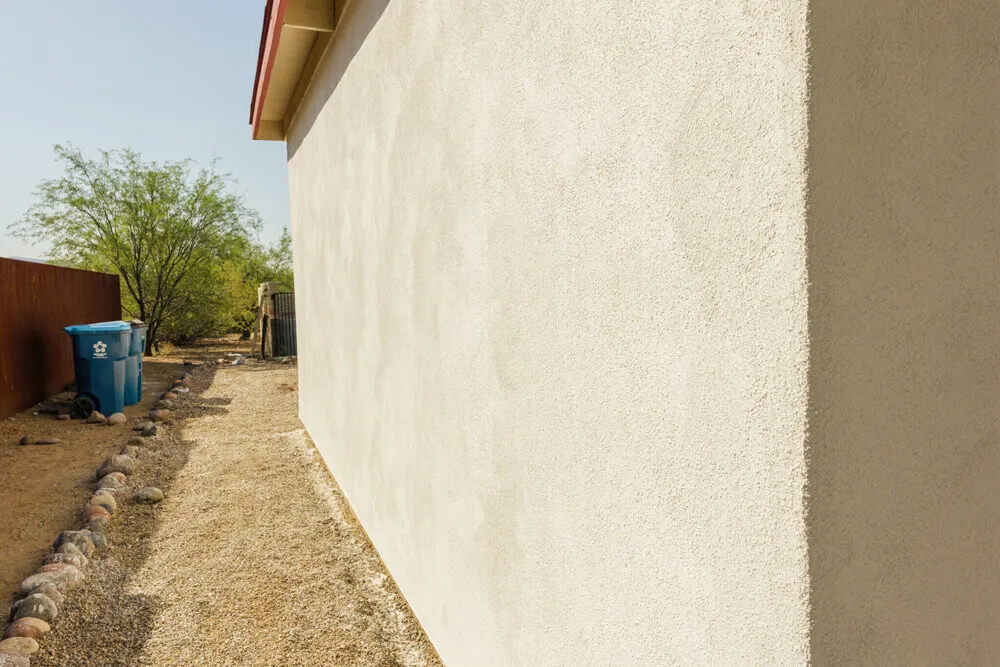
Sand finish is the plainest of the common stucco finishes. A uniform granular surface, no pattern, no trowel marks, just consistent texture across the wall.
It looks like the easiest finish to repair. It is not, and the reason is worth understanding before somebody patches your wall.
The three grades
Sand finish comes in grades determined by the aggregate size in the finish coat.
Fine. Almost smooth to the eye, slightly gritty to the touch. Reads as a clean modern surface. Common on newer builds and contemporary remodels.
Medium. The most common. Clearly textured, comparable to medium sandpaper. The default sand finish on most Valley homes that have one.
Coarse. Pronounced grain, noticeably rough. More common on older homes and on commercial work.
The grades are not interchangeable, and this is the whole problem with repairing sand finish.
Why matching it is harder than it looks
The grain size has to match exactly. There is no pattern to distract the eye, so the only visual information on the wall is the texture of the aggregate. A patch done in medium grade against a fine grade wall is obvious from across the street, even in flat light.
Aggregate varies by supplier. Two bags both labeled medium from different manufacturers can produce visibly different results. Matching a wall finished in 2002 means finding an aggregate that behaves like whatever was used then.
Application pressure changes the look. The same mix floated with more pressure produces a tighter, finer-looking surface. Getting the grain right is partly the mix and partly how it is worked.
There is no texture shadow to hide the edge. Like Santa Barbara, sand finish gives a patch nowhere to disappear into. Less brutal than a smooth wall, but the transition still has to be feathered rather than stopped at a hard line.
The upside: once the grain is matched correctly, sand finish repairs look excellent, because the finish is so uniform that a correct match is genuinely invisible.
How sand finish ages in Phoenix
Fading is even. No high and low areas means UV hits the whole surface equally, so you do not get the patchy look some textures develop.
Cracks are moderately visible. More visible than on lace, far less than on Santa Barbara. Hairlines tend to read as fine lines rather than disappearing.
It stays cleaner than textured finishes. Less relief means less place for dust to collect, which matters after a haboob.
Coarse grades can shed aggregate. After fifteen or twenty years of UV breaking down the binder at the surface, some coarse sand finishes start releasing grain when you brush against them. That usually signals the finish coat is reaching the end of its life.
Repairing sand finish
The process is the same texture and color matching work as any finish, with the emphasis on grain.
We sample the existing wall first, matching aggregate grade against the actual surface rather than guessing from a photo. Test patches go somewhere inconspicuous and cure fully before we judge, because both color and apparent grain change as the material dries.
Then the repair is applied and feathered out past the damage, and the surface worked at the same pressure as the surrounding wall.
If the wall has started shedding aggregate, patching it is a short-term fix. At that point re-coating the elevation usually makes more sense, and we will say so rather than sell you a patch that fails in two years.
Common questions
Is sand finish the same as a float finish?
Closely related. Float finish describes how it is worked, with a float rather than a steel trowel, and sand finish describes the resulting granular surface. In practice people use the terms interchangeably.
How do I know which grade I have?
Run your palm across it. Fine feels like fine sandpaper, coarse feels like you could scrape yourself on it. A close-up photo with something for scale, like a coin, tells us immediately.
Is sand finish more durable than lace?
About the same. Durability comes from how well the system was applied, not from the finish texture.
Why is my sand finish wall shedding grit?
The binder at the surface has broken down under UV, usually after fifteen or twenty years. It means the finish coat is near the end of its service life. Patching will not stop it spreading.
Can I paint sand finish stucco?
Yes, and elastomeric coatings work well on it. Just repair any cracks first, or they telegraph through.
Will a repair be invisible?
If the grain is matched correctly, genuinely yes. Sand finish is more forgiving than Santa Barbara because the uniform texture gives a correct match nowhere to go wrong.
Have a sand finish wall that needs work?
Text a close-up to 602-228-5012, with a coin or a finger in frame for scale, and we will tell you the grade and what matching it involves.
Send the photo, get the number
Send a photo of the damage to 602-228-5012 and you get a price range back the same day. Nobody standing in your driveway, no waiting on a written estimate to find out roughly what you are looking at.
Stand back far enough to show the whole wall, then take one close-up of the damage. That is usually enough. If it is not, we will tell you what else to send.
Monday to Saturday, 7am to 6pm · Prefer to talk it through? Call 602-228-5012