Weep Screed and Stucco Drainage
Text a photo. Get a ballpark price the same day.
Send a photo of the damage to 602-228-5012 and you get a price range back the same day. Nobody standing in your driveway, no waiting on a written estimate to find out roughly what you are looking at.
Stand back far enough to show the whole wall, then take one close-up of the damage. That is usually enough. If it is not, we will tell you what else to send.
Monday to Saturday, 7am to 6pm · Prefer to talk it through? Call 602-228-5012
The weep screed is a metal strip at the bottom of a stucco wall with small openings along it. It is the least interesting component in the whole system and one of the most important.
Its job is to let water out. When it cannot, water stays in the wall.
What it does
Stucco is not waterproof. It is water-resistant, and the system behind it is designed to let whatever gets through drain away. Behind your finish coat there is lath, and behind the lath there is a weather-resistive barrier, usually building paper.
Water that gets past the stucco runs down the face of that barrier. The weep screed is where it exits.
The screed also establishes the bottom edge of the stucco and creates a drip line so water falls clear of the foundation instead of wicking back against it.
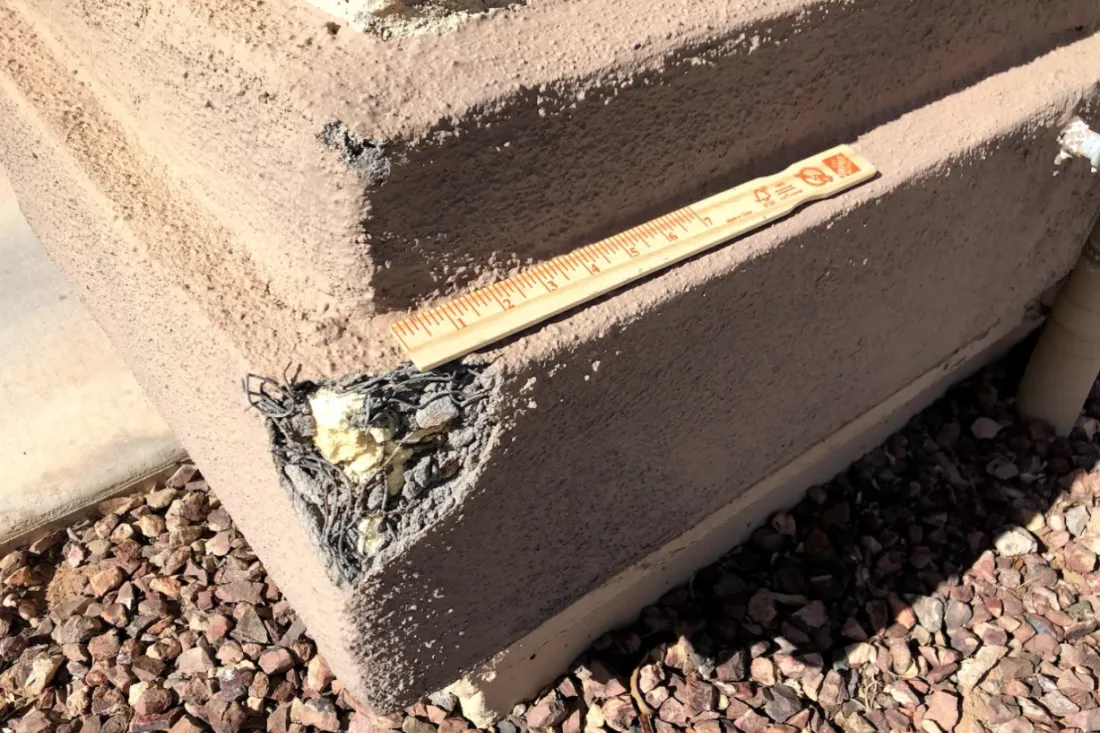
If the screed is blocked, buried or missing, the water has nowhere to go. It sits in the bottom of the wall assembly, saturates the lath and paper, rusts the lath, and eventually the stucco delaminates from the base up.
The clearance it needs
Code requires the weep screed to sit a minimum distance above adjacent surfaces so it can actually drain:
- At least 4 inches above earth or soil
- At least 2 inches above paved surfaces, such as a patio slab, walkway or driveway
Those numbers exist because anything less means splash-back, standing water and capillary action pulling moisture straight back into the wall.
Going outside right now and checking the base of your walls against those two numbers is probably the single most useful five minutes of home maintenance available to a Phoenix homeowner.
Why it gets buried in Phoenix
This is close to a universal problem in the Valley, and it is almost always landscaping done years after the house was built.
Decorative gravel. Nearly every Valley yard has it, it gets topped up over time, and each layer raises the grade against the house. Two or three refreshes over fifteen years is easily enough to bury a screed that started with correct clearance.
Raised planters and garden beds against the wall. Soil piled against stucco, usually with a drip line running through it.
Patios and pavers added later. A slab poured at the wrong height leaves under two inches of clearance permanently.
Artificial turf. Increasingly common, and the base material plus the turf itself often ends up above the screed line.
Grade change from erosion or settling. Less common, but soil moves.
What it looks like when drainage has failed
- Efflorescence, the white chalky residue, along the bottom foot of the wall
- Stucco delaminating or crumbling at the base
- Soft spots when you press low on the wall
- Staining that runs upward from the bottom rather than down from above
- Rust streaks bleeding through from failed lath
- Paint bubbling in a band along the base
The tell is that the damage is worst at the bottom and improves as you go up. Water coming from above produces the opposite pattern.
Irrigation makes it worse
A drip line or a misaligned sprinkler head hitting the base of a wall for years is a slow saturation problem, and it runs at four in the morning when nobody is watching.
Combine buried drainage with irrigation overspray and you get the most common water failure we see on Valley homes: a wall that is wet at the base for years, with the lath rusting quietly behind intact-looking stucco, until a section suddenly lets go.
What can be done
Lower the grade. Often the whole fix. Pulling gravel, soil or turf base back to restore clearance solves the problem without touching the wall, and it costs almost nothing.
Redirect irrigation. Move drip emitters away from the wall, realign spray heads.
Repair the damage. Where the base of the wall has already failed, the affected stucco comes off, the lath and paper get replaced, and the section is rebuilt and matched.
Add drainage. In problem areas, a gravel trench or a French drain at the base keeps water moving away.
The order matters. Repairing the wall without fixing the grade means repairing it again.
Common questions
What is a weep screed?
A perforated metal strip at the bottom edge of a stucco wall that lets water drain out of the wall assembly and establishes a drip edge away from the foundation.
How much clearance does a weep screed need?
At least 4 inches above soil, at least 2 inches above paved surfaces like patios and walkways.
How do I check mine?
Look at the bottom of an exterior wall where the stucco ends. You should see a metal edge with a small gap beneath it and daylight under the drip lip. If gravel, soil or concrete is touching or covering it, it is buried.
My gravel covers it. Is that a real problem?
Yes, and it is extremely common here. Water cannot exit the wall, so it stays in the base of the assembly. Pulling the gravel back is cheap and prevents an expensive repair.
What if my house does not have a weep screed at all?
Some older Valley homes, particularly block construction, were built without one. That changes how the wall handles moisture and is worth having assessed rather than assumed.
Can a weep screed be added to an existing wall?
The bottom section of stucco has to be cut back and rebuilt, so it is real work rather than a quick fix. Sometimes worth it on a wall with recurring base damage.
Does this apply to block walls too?
Block behaves differently and usually has no screed. The same principle applies though: soil and gravel piled against a block wall causes efflorescence and spalling. More on block wall repair
Worried about the base of your wall?
Text a photo to 602-228-5012 showing where the wall meets the ground, and we will tell you what you are looking at.
Send the photo, get the number
Send a photo of the damage to 602-228-5012 and you get a price range back the same day. Nobody standing in your driveway, no waiting on a written estimate to find out roughly what you are looking at.
Stand back far enough to show the whole wall, then take one close-up of the damage. That is usually enough. If it is not, we will tell you what else to send.
Monday to Saturday, 7am to 6pm · Prefer to talk it through? Call 602-228-5012