Stucco Finish Types: A Guide for Phoenix Homeowners
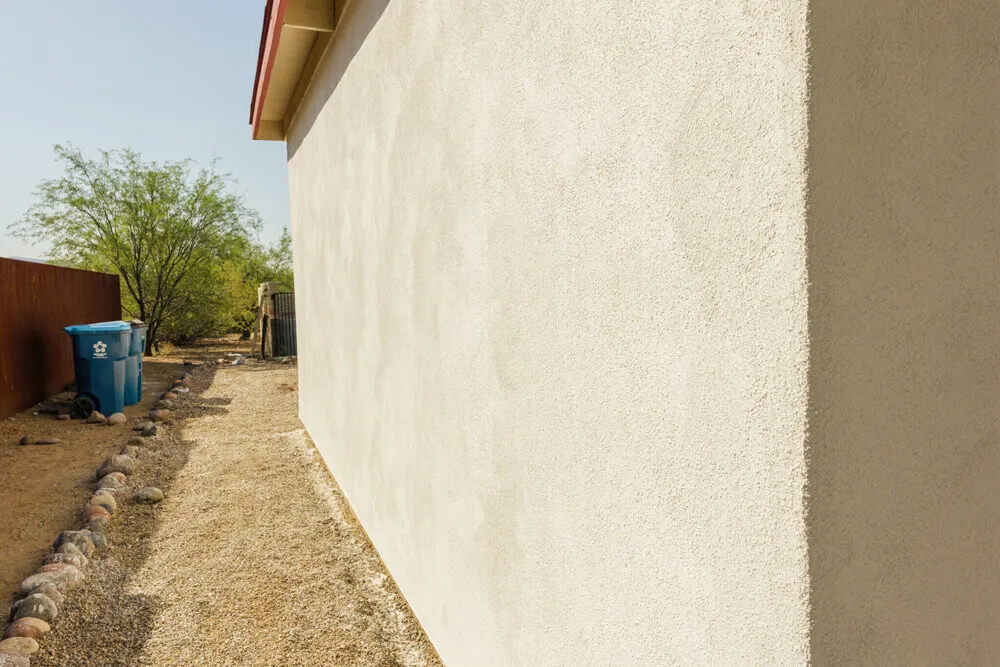
Text a photo. Get a ballpark price the same day.
Send a photo of the damage to 602-228-5012 and you get a price range back the same day. Nobody standing in your driveway, no waiting on a written estimate to find out roughly what you are looking at.
Stand back far enough to show the whole wall, then take one close-up of the damage. That is usually enough. If it is not, we will tell you what else to send.
Monday to Saturday, 7am to 6pm · Prefer to talk it through? Call 602-228-5012
Most people have no idea what finish is on their house until they need it repaired. Then it matters a great deal, because the finish determines how hard the repair is, what it costs, and whether you will be able to see it afterward.
Here is how to identify what you have.
The quick test
Stand two feet from the wall and look at it, then run your hand across it.
| What you see and feel | Likely finish |
|---|---|
| Raised and flattened areas in an irregular troweled pattern | Lace, or lace and skip |
| Uniform gritty texture, like coarse sandpaper | Sand finish |
| Smooth with gentle waves, slight sheen | Santa Barbara |
| Distinct sprayed droplets or aggregate bumps | Dash |
| Sprayed then flattened, with plateaus | Knockdown |
| Curling worm-like grooves | Worm or swirl |
Still not sure? Send a close-up photo to 602-228-5012 and we will tell you.
Lace and lace-and-skip
By far the most common finish in the Valley. If your house was built between about 1985 and 2010, this is probably what you have.
Applied by trowel in a deliberately irregular pattern, leaving raised areas and flattened ones. Lace-and-skip is the same idea with more flattened “skip” areas showing through.
Repair difficulty: hard. Not because the material is difficult, but because the pattern has a rhythm to it that comes from how a specific person moved a trowel. A patch applied with a different hand motion reads as a patch even when the color is perfect. Matching lace convincingly is the thing that separates experienced repair work from average.
How it ages: hides hairline cracks well, holds dust in the recesses, generally durable.
Sand finish
Uniform granular texture, available in fine, medium and coarse grades. Common on both older Valley homes and newer builds going for a cleaner look.
Repair difficulty: moderate. It looks like the easiest finish to match and it is not. The grain size has to match exactly, and a patch with slightly coarser or finer aggregate catches light differently than the wall around it.
How it ages: wears evenly, shows fading uniformly, moderate crack visibility. More on sand finish
Santa Barbara
Smooth, hand-troweled, with a subtle undulation and a slight burnished sheen. Common on Spanish-style and higher-end homes in Arcadia, Paradise Valley and north Scottsdale.
Repair difficulty: hardest. There is no texture to hide a transition, so the repair has to be feathered far wider than the damage itself. Raking afternoon light exposes any deviation in plane.
How it ages: holds up well, but shows every crack clearly because there is no pattern to disguise them. Full guide to Santa Barbara
Dash and knockdown dash
Dash is sprayed on, leaving a surface of distinct droplets or aggregate. Knockdown is dash that has been lightly flattened with a trowel, creating small plateaus with texture between them.
Repair difficulty: moderate. Matching requires matching both the spray pattern and the aggregate size, which means getting the equipment settings and the mix right rather than relying on hand technique.
How it ages: very durable, excellent at hiding cracks, collects dust in the texture.
Worm and swirl
Older decorative finishes with curling grooves or circular patterns. Mostly on Valley homes from the 1960s through early 80s.
Repair difficulty: hard, and specialized. Few people still apply these, so matching one means reverse-engineering a technique nobody uses. Doable, but it takes longer.
How it ages: the deep grooves hold water and dust, which accelerates wear in some spots.
Why this matters for your repair
Three practical reasons.
Cost. A patch on a sand finish wall and the same patch on a Santa Barbara wall are different jobs at different prices. Finish complexity is one of the main things that moves a quote.
Time. Harder finishes need test samples and cure time before the final application, which means more than one visit.
Expectations. On a heavily textured wall, an invisible repair is a realistic goal. On a smooth wall in raking light, “very close” is the honest standard. Anyone promising otherwise has not done many of them.
How texture and color matching works
Common questions
Can I change my stucco finish?
Yes, but it is a re-coat rather than a repair. The existing surface has to be prepared and a new finish coat applied across the whole elevation, or it will be obvious where the old finish stops.
Which finish is best for Arizona?
All of the common ones hold up fine here if applied correctly. Heavier textures hide cracks better. Smoother finishes show less dust. It is mostly an aesthetic decision, not a durability one.
Does my HOA control my finish?
Often yes, particularly in master-planned communities. Colors are usually more tightly controlled than textures, but check before changing either.
My house has different finishes on different walls. Why?
Usually a previous repair or an addition where somebody did not match the existing finish. It is fixable.
What if my finish does not look like any of these?
Send a photo. There are regional and custom variants, and twenty years of Valley walls covers most of them.
Not sure what you have?
Text a close-up to 602-228-5012 and we will identify it and tell you what repairing it involves.
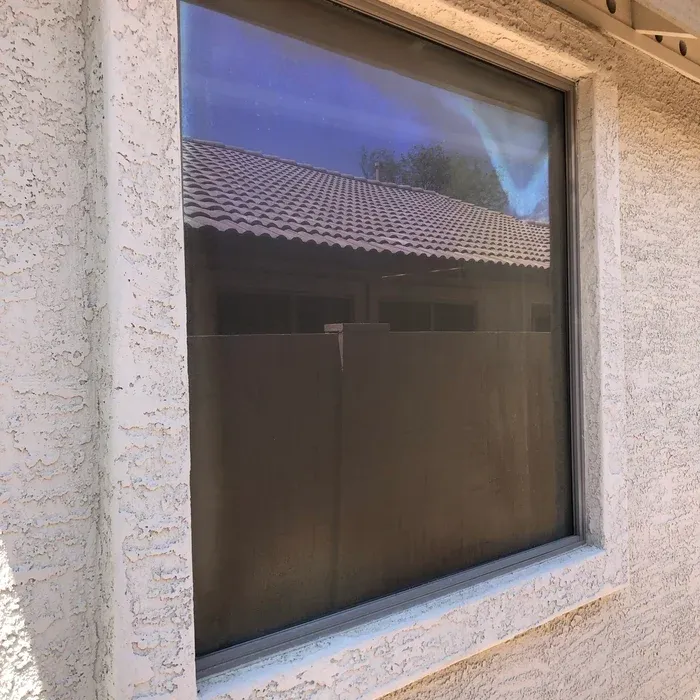
Send the photo, get the number
Send a photo of the damage to 602-228-5012 and you get a price range back the same day. Nobody standing in your driveway, no waiting on a written estimate to find out roughly what you are looking at.
Stand back far enough to show the whole wall, then take one close-up of the damage. That is usually enough. If it is not, we will tell you what else to send.
Monday to Saturday, 7am to 6pm · Prefer to talk it through? Call 602-228-5012