Stucco Water and Monsoon Damage Repair
Text a photo. Get a ballpark price the same day.
Send a photo of the damage to 602-228-5012 and you get a price range back the same day. Nobody standing in your driveway, no waiting on a written estimate to find out roughly what you are looking at.
Stand back far enough to show the whole wall, then take one close-up of the damage. That is usually enough. If it is not, we will tell you what else to send.
Monday to Saturday, 7am to 6pm · Prefer to talk it through? Call 602-228-5012
Water damage in stucco almost never shows up where the water got in. It travels behind the wall and appears somewhere lower, which is why patching the stain accomplishes nothing.
Finding the actual entry point is most of this job.
Call 602-228-5012
How to tell if water is behind your stucco
You usually cannot see it directly. What you can see:
Staining or streaking running down a wall, often below a window, a roofline or a penetration.
Soft or spongy spots. Press firmly with your palm. Sound stucco does not give. If it flexes or crunches, the material behind it has failed.
Bubbling or blistering paint, where moisture is pushing out from behind the coating.
White chalky residue, which is efflorescence. Mineral salts carried to the surface by water moving through the wall. Cosmetically minor, diagnostically significant.
A hollow sound when you tap. A change in tone across a section usually means delamination.
Interior clues. Drywall staining, baseboard warping, or a musty smell along an exterior wall.
Any two of these together is worth a call.
Monsoon damage
Most of our water calls come July through September, and the mechanism is specific to here.
Nine months of dry heat opens up sealant joints and hairline cracks. Then monsoon storms arrive with 40 to 60 mph gusts driving rain horizontally into a wall that was never designed for sideways water. A gap that sheds a vertical rain perfectly well lets a horizontal one straight in.
Haboobs make it worse. Dust drives into open joints ahead of the rain, then the rain packs it in, and you end up with material sitting in a gap holding moisture against the wall.
Damage often surfaces weeks after the storm, once what is behind has stayed wet long enough to fail.
The practical takeaway: the time to seal a wall is May and June. Sealing in August is repair, not prevention.
Irrigation damage
This one is underrated and we see it constantly.
A drip line that has come loose, or a sprinkler head that got knocked out of alignment, can spray the base of a wall multiple times a week for years. Nobody notices because it runs at 4am. The result is saturated stucco at grade, efflorescence, delamination, and eventually failed lath right where you cannot see it behind a shrub.
Same story with gravel and soil built up over the weep screed, which is the drainage gap at the bottom of the wall. Landscaping installed years after the house was built very often buries it. More on weep screed
If you have plants against the house, pull them back and look at the base of the wall. It is a two-minute check that saves real money.
Where water actually gets in
In rough order of how often we find it:
- Window and door perimeters. Failed sealant or flashing that was wrong from the start. By far the most common. More on window repairs
- Grade and weep screed. Buried drainage, irrigation overspray, patio slabs poured too high.
- Penetrations. Hose bibs, dryer vents, light fixtures, conduit, solar mounts.
- Roof to wall junctions, parapet caps and scuppers. Especially on flat-roof homes. More on parapets
- Open cracks, usually a contributing path rather than the primary source.
How we repair it
Find the source. Visual inspection, moisture readings, and sometimes water testing to confirm.
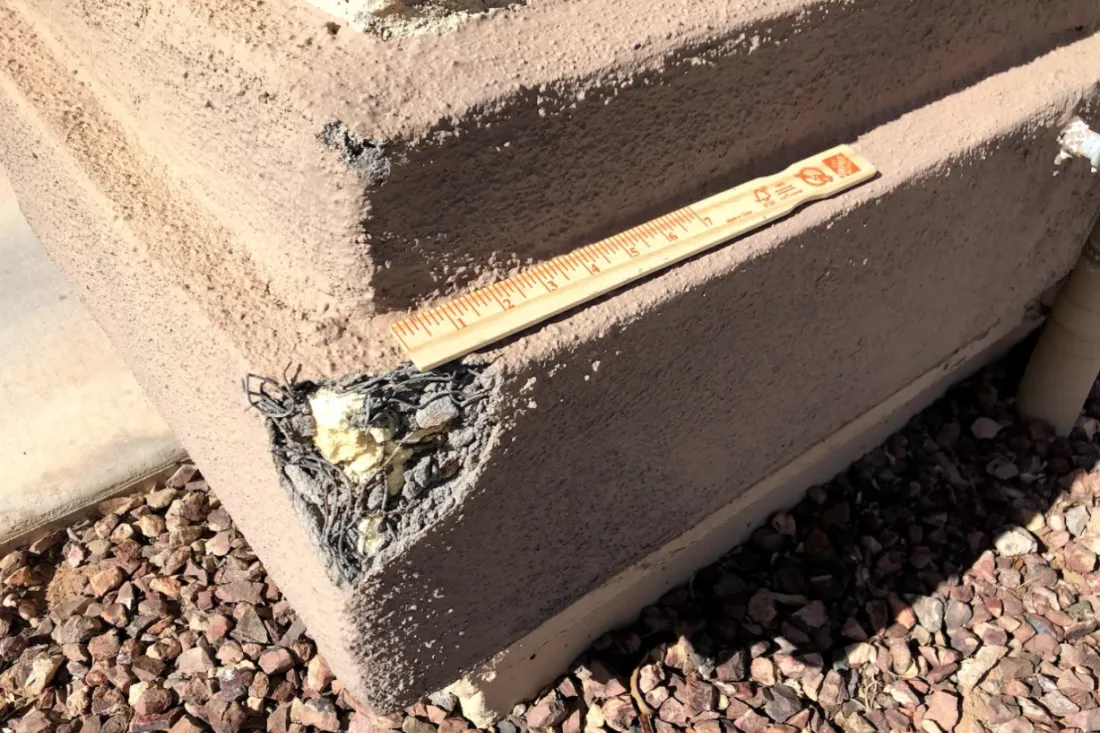
Open up the damage. We have to see how far it spread, and it is almost always larger than the visible symptom.
Replace what failed. Damaged lath, paper and sheathing come out. Rusted lath is common in older Valley homes and it will not hold a repair.
Fix the entry point. Flashing, sealant, screed clearance, irrigation adjustment. Skip this and you are repairing the same wall after the next monsoon.
Rebuild and match. Proper coats, then texture and color matched to the surrounding wall.
What it costs
| Scope | Typical range |
|---|---|
| Sealing an entry point, minor surface repair | $300 to $700 |
| Localized damage, lath replacement, one area | $800 to $2,500 |
| Extensive damage across an elevation | $2,500 to $8,000+ |
Honest caveat: this is the hardest category to quote from a photo, because the extent stays hidden until we open it. We will give you a ballpark and a firm number after we look.
Common questions
How urgent is it?
More than most people assume. Water behind stucco rots sheathing and framing, and that repair costs an order of magnitude more than the stucco. If you have soft spots, do not wait for next season.
Will homeowners insurance cover this?
Sometimes, for a sudden event like storm or hail damage. Usually not for gradual deterioration or maintenance issues, which is how most of it gets classified. Worth calling your carrier. We can document what we find either way.
Can you just seal over it?
No, and anyone offering to will cost you more later. Sealing wet material traps the moisture against the wall.
Is mold a concern?
It can be where there has been prolonged moisture against organic material. Our dry climate helps, but a wall that has been wet behind the surface for a year is its own environment. If we find it beyond a small area we will tell you, and remediation is a different trade.
Should I wait until after monsoon season to fix it?
No. Every storm between now and then makes it worse. If anything, an active leak during monsoon is the most urgent version of this.
What does hail damage to stucco look like?
Small circular chips or pockmarks, usually concentrated on one elevation facing the storm direction. Often mistaken for age. Worth documenting quickly if you plan to file a claim, since carriers apply time limits.
Get it looked at
Call 602-228-5012. If you are seeing soft spots, call rather than text. Those move to the front of the list.
Send the photo, get the number
Send a photo of the damage to 602-228-5012 and you get a price range back the same day. Nobody standing in your driveway, no waiting on a written estimate to find out roughly what you are looking at.
Stand back far enough to show the whole wall, then take one close-up of the damage. That is usually enough. If it is not, we will tell you what else to send.
Monday to Saturday, 7am to 6pm · Prefer to talk it through? Call 602-228-5012