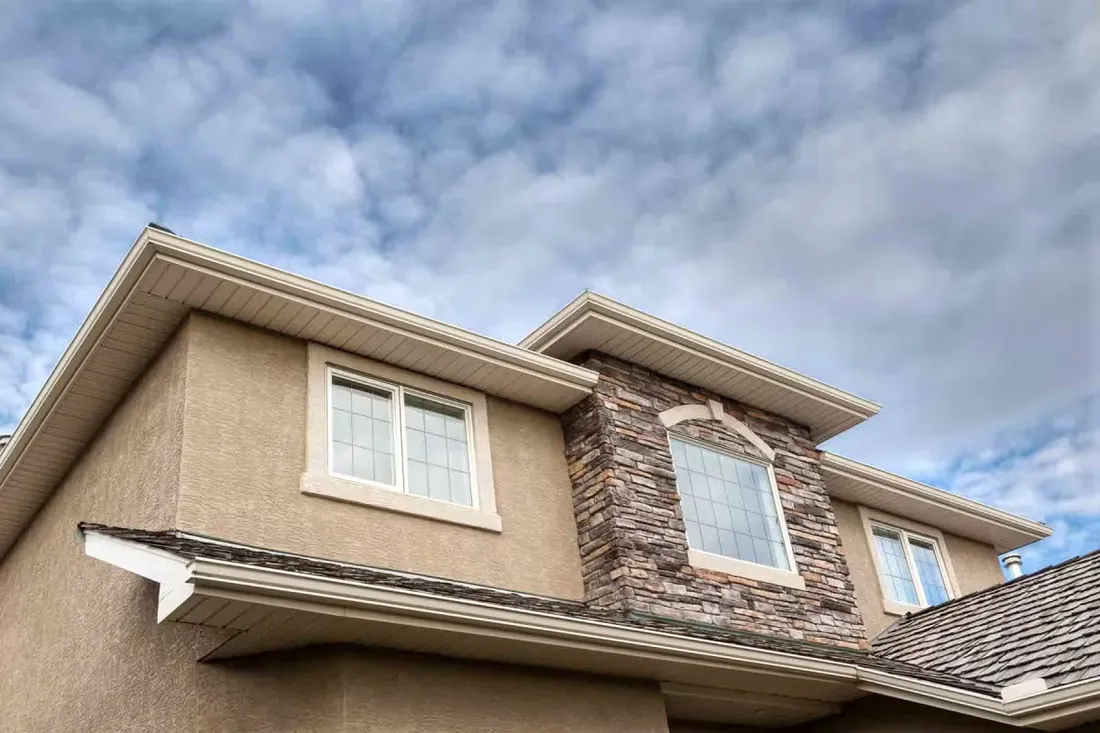
Stucco at the Roofline
Text a photo. Get a ballpark price the same day.
Send a photo of the damage to 602-228-5012 and you get a price range back the same day. Nobody standing in your driveway, no waiting on a written estimate to find out roughly what you are looking at.
Stand back far enough to show the whole wall, then take one close-up of the damage. That is usually enough. If it is not, we will tell you what else to send.
Monday to Saturday, 7am to 6pm · Prefer to talk it through? Call 602-228-5012
The line where stucco meets the roof is a seam, and seams are where buildings leak.
It is also the boundary between two trades. Roofers work down to it and stop. Stucco companies work up to it and stop. The failures happen in the gap between, which is why they go unaddressed for years.
Call 602-228-5012
Where it fails
Roof-to-wall flashing. Where a sloped roof meets a vertical stucco wall, flashing is supposed to direct water out onto the roof surface. When it was installed short, installed backwards, or has corroded, water runs behind the stucco instead.
Parapet caps. On flat-roof homes, the top of the parapet wall. The most common water entry point on that style of house. More on parapets
Scuppers. The drainage openings through a parapet. All the roof water funnels through them, so a small sealant failure moves a lot of water.
Fascia and eave junctions. Where stucco returns into the soffit or meets the fascia board. Often the last thing anyone coated properly, and the first thing to open up.
Stucco soffits. The underside of an eave finished in stucco rather than wood or vinyl. These fail from above, from water that got in elsewhere, and the sagging or staining you see is usually the end of a longer path.
Chimney junctions. Where the chase meets the roof plane. More on chimney repair
How you find out
Almost never by looking at the roofline. Usually:
- A stain on an interior ceiling near an exterior wall
- Bubbling or soft stucco high on an elevation
- Staining running down from under the eave
- Sagging or discoloration in a stucco soffit
- A roofer mentioning it while doing something else
- Water that only appears during wind-driven rain, not steady rain
That last one is the diagnostic. Wind-driven monsoon rain gets into junction details that shed vertical rain without difficulty.
Why the trade boundary matters
This is worth understanding before you call anyone, because it determines who can actually help.
A roofer’s responsibility ends at the roof membrane or the tile field. A stucco contractor’s responsibility ends at the wall surface. The flashing, the counterflashing, the transition detail and the sealant at the junction sit between the two, and both trades will honestly tell you it is the other one’s area.
The practical answer is that somebody has to look at both sides. We handle the stucco side, we can tell you clearly what we think is happening at the junction, and where the membrane itself needs work we coordinate rather than working past our trade.
If you already have a roofer you trust, we work alongside them regularly. More for trade partners
What we repair
Stucco damage at roof-to-wall junctions. Parapet caps and both faces of parapet walls. Scupper penetrations and the surrounding wall. Stucco soffits and eave returns. Fascia junctions where stucco meets trim. Chimney chases.
In each case we look at the water path first. Rebuilding the stucco without addressing what let the water in produces a repair that fails at the next storm.
What it costs
| Job | Typical range |
|---|---|
| Sealing a junction, minor repair | $400 to $800 |
| Soffit or eave return repair | $500 to $1,500 |
| Scupper reseal and surrounding wall | $500 to $1,200 |
| Parapet cap repair | $600 to $3,000 |
| Section repair with lath replacement | $1,200 to $2,500 |
Access drives the number more than the size of the repair.
Common questions
Is this a roofing problem or a stucco problem?
Usually both, which is exactly why it goes unfixed. The failure sits at the junction between the two trades. We handle the stucco side and coordinate on the rest.
My ceiling is staining near an outside wall. Where do I start?
On a flat roof, suspect the parapet or a scupper first. On a pitched roof, suspect roof-to-wall flashing. Either way it is worth having both the stucco and the roof looked at rather than guessing.
Why does it only leak when it is windy?
Wind-driven rain gets into junction details that handle vertical rain fine. That pattern points strongly at a flashing or sealant issue rather than a field leak in the roof.
Can you repair a stucco soffit?
Yes. The important part is working out what put water into it, because soffit damage is almost always the end of a path that started higher up.
Do you work with roofers?
Regularly. If you have one you trust, we coordinate. If you do not, we will tell you honestly what we think the roof side needs.
How often should I check the roofline?
Once a year before monsoon season. Look for cracked sealant at junctions, staining under eaves, and anything sagging or discolored in a soffit.
Get it looked at
Call 602-228-5012. Mention whether you have a flat or pitched roof so we can plan access.
Send the photo, get the number
Send a photo of the damage to 602-228-5012 and you get a price range back the same day. Nobody standing in your driveway, no waiting on a written estimate to find out roughly what you are looking at.
Stand back far enough to show the whole wall, then take one close-up of the damage. That is usually enough. If it is not, we will tell you what else to send.
Monday to Saturday, 7am to 6pm · Prefer to talk it through? Call 602-228-5012